Showing posts with label Periyar Tiger Reserve. Show all posts

Thursday, May 17, 2012

Big Frog, Orange Frog, Forest Frog

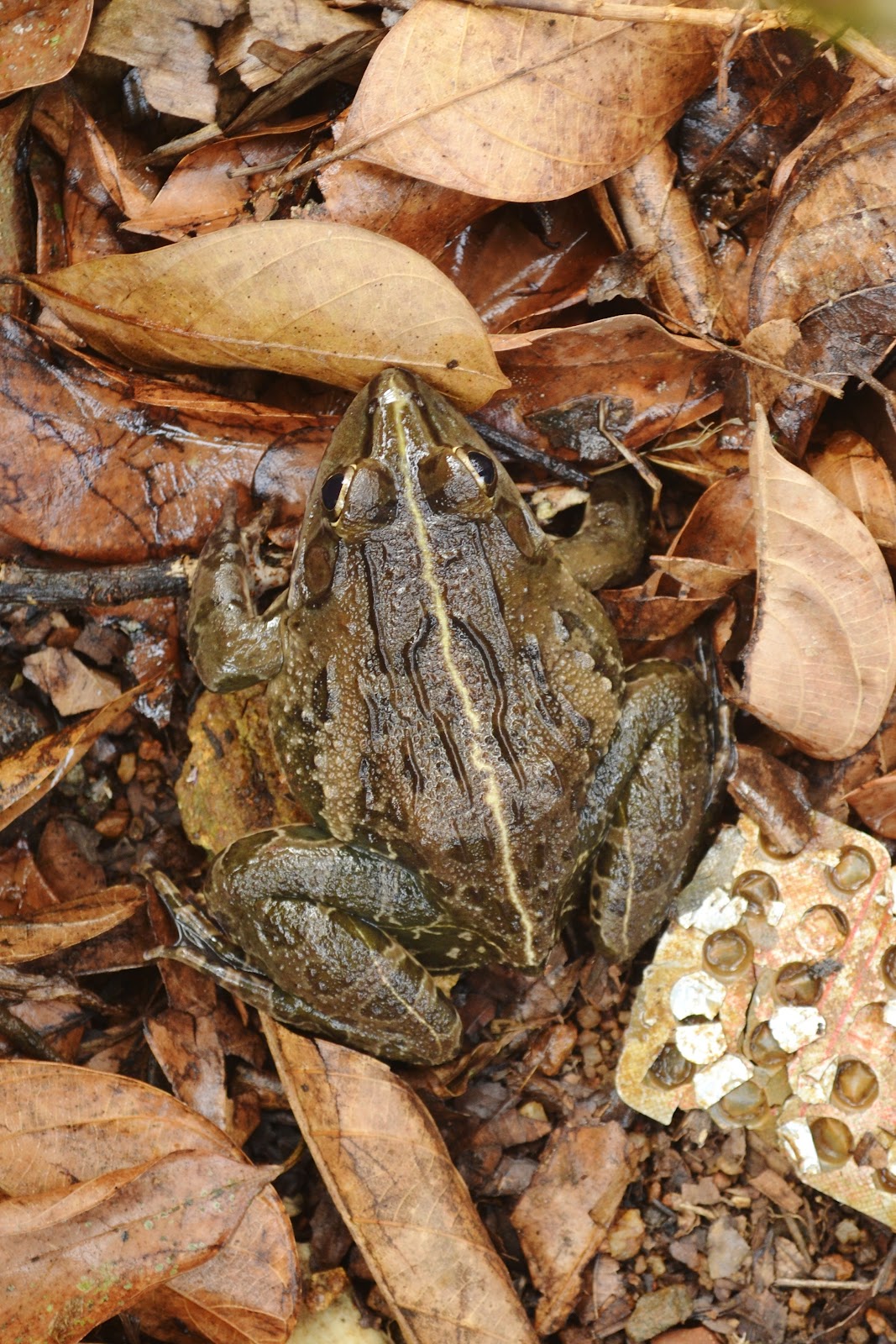
Unlike many other wild creatures, amphibians like frogs aren't that commonly seen in my locality nowadays, perhaps due to urbanization which has depleted their population. The only amphibians you commonly do see here are Asian Toads (they are really common) and these large frogs that spend most of their time in water.


For once I caught this guy outside after a spell of rain. Usually, these big frogs spend their entire day in my outdoor pond, and only head out at night.


The distinct yellow line that runs along its back shows that it belongs to the family of fanged frogs.

A few days back I happened to come across a new species of frog in this region - one that was brightly and beautifully coloured.


I spotted this guy one night outside my neighbor's house. I love it's colours and patterns! Bright orange back with tiny black dots, and black and white legs!


The frog was extremely friendly and allowed me to take some pretty close-up shots.


Lastly, I had come across a medium-sized frog in the Periyar Tiger Reserve. This fella was hiding in the buttress of a really large tree. I'm not exactly sure of what species this is, but it does look similar to the colourful one above.

Wednesday, May 16, 2012

Oh, Snap!


As I was leaving the Periyar Tiger Reserve, I heard several loud calls from a nearby tree, and upon a closer look, realized it was a Malabar Grey Hornbill. And since I'm not the kind of guy who's so used to seeing such big and beautiful wild birds, I got really excited. It was the first time spotting this bird, and I wanted to get some good photographs. But well, you never always get what you want at the first try, so before I could even get close to it, the bird flew off. All I have is this shot, perhaps just enough for identification.

Saturday, May 12, 2012

Indian Dhole

I've kept the best things for last.
The highlight of the entire trip to Periyar Tiger Reserve is without doubt the sighting of several Indian Wild Dogs, also called Dholes. These canines were feasting on a fresh wild sambar on the bank of the lake.


I wasn't expecting this during the ride. We didn't spot this group of Dholes on the way into the lake (it's a to and fro course), but only on the way back. That meant one thing- these Dholes had attacked and killed the sambar deer as we were travelling deeper into the lake.


As our boat drew closer to the scene, most of the dogs fled further up the bank. They are known to be fearful of humans.


There was, however, this particular daring individual who stood his spot, not letting go of his precious meal.


He looks up at us, and then continues feasting. As you can see, the water around the sambar had become bloody red. 


The deer is about thrice the size of the dhole, but since these dogs hunt in packs, they are bold enough to attack and overpower large and dangerous animals such as wild boars, water buffaloes and even tigers.


Dholes are classed as endangered by the IUCN, due to ongoing habitat loss, depletion of its prey base, competition from other predators and possibly diseases from domestic dogs. I could consider myself lucky to have spotted a pack in action.

Thursday, May 10, 2012

Nilgiri Langurs

Nilgiri Langurs, or Nilgiri Leaf Monkeys are an endangered species of old world monkeys found mainly in South India. As I was driving along one of the roads in the reserve, I spotted a group of these Langurs hanging around on the trees overhead, watching the cars and people pass by.


These monkeys used to be a common species in India, but are now considered endangered due to excessive poaching and habitat loss which has resulted in a drastic decrease in their population. I spotted one individual during the boat ride too, but only for a few seconds short of grabbing a shot. The ones here were difficult to photograph as well as the back-light made their bodies dark and unrecognizable.


Anyway, the extremely common Lion-Tailed Macaques were abundant in the reserve.

Wednesday, May 9, 2012

Wild Mammals around Periyar Lake

As I mentioned earlier, most of the wildlife we encountered in the reserve were during the boat ride in the lake. Apart from birds, Sambar deer were extremely common along the banks of the lake. They were always seen grazing on the grass in groups.


Birds in the foreground and deer in the background


A small Smooth Otter captured my eye during the ride, but unfortunately, the boat was pretty far away and the otter only stayed for a few seconds on the bank before diving back into the deep water. These cute little creatures are supposed to be rather common here.


Wild Bison were considered a common species here, but we only spotted 2 groups of these beasts.
 I'm guessing they don't head out during rainy or dewy weather.


It's not that easy to tell from the boat, whether the animals were bison or deer, due to the distance and the fog. Had it been a bright and sunny day, the chances of spotting wildlife would have been more, and I could have been able to photograph better too.

Saturday, April 28, 2012

Birds of Periyar II

Most of the birds I spotted within the reserve's lake were water birds, like Cormorants and Snakebirds. I had a little more luck when it came to shooting these Snakebirds, as they would sit there on their spot quietly and watch us pass by in our boat.


Snakebirds, also known as Darters, are water birds found mainly in the tropics. These birds are usually found in freshwater lakes like these, as well as rivers, swamps and marshes. They are called 'snakebirds' due to their thin and long necks, which resemble snakes, especially when they swim in water with their bodies submerged.


These birds are rather sociable; they usually mix and hunt together with other water birds like Herons and Cormorants. Although they are known to gather in flocks, the ones I spotted here in Periyar were lonesome individuals.


There was another common species of Darter in the reserve, a slightly larger one. However, I could only snap a single shot of the bird, that too a rather mug one. Certainly, my 200mm can't be used for serious birding!


Apart from these Snakebirds, another common bird was the White-Throated Stork (or Wooly-Necked Stork). Despite the fact that they are rather large birds, my photographs didn't turn out too well as the birds seemed rather shy, and flew off when we got close.


An individual flies off as our boat drives closer.


I managed to grab these two shots of the bird in flight, by pure luck!


Sure enough, shooting birds in Periyar was a great experience for me and it enhanced my birding skills. What about the other wild animals in the reserve? Coming up next.

Friday, April 27, 2012

Birds of Periyar I

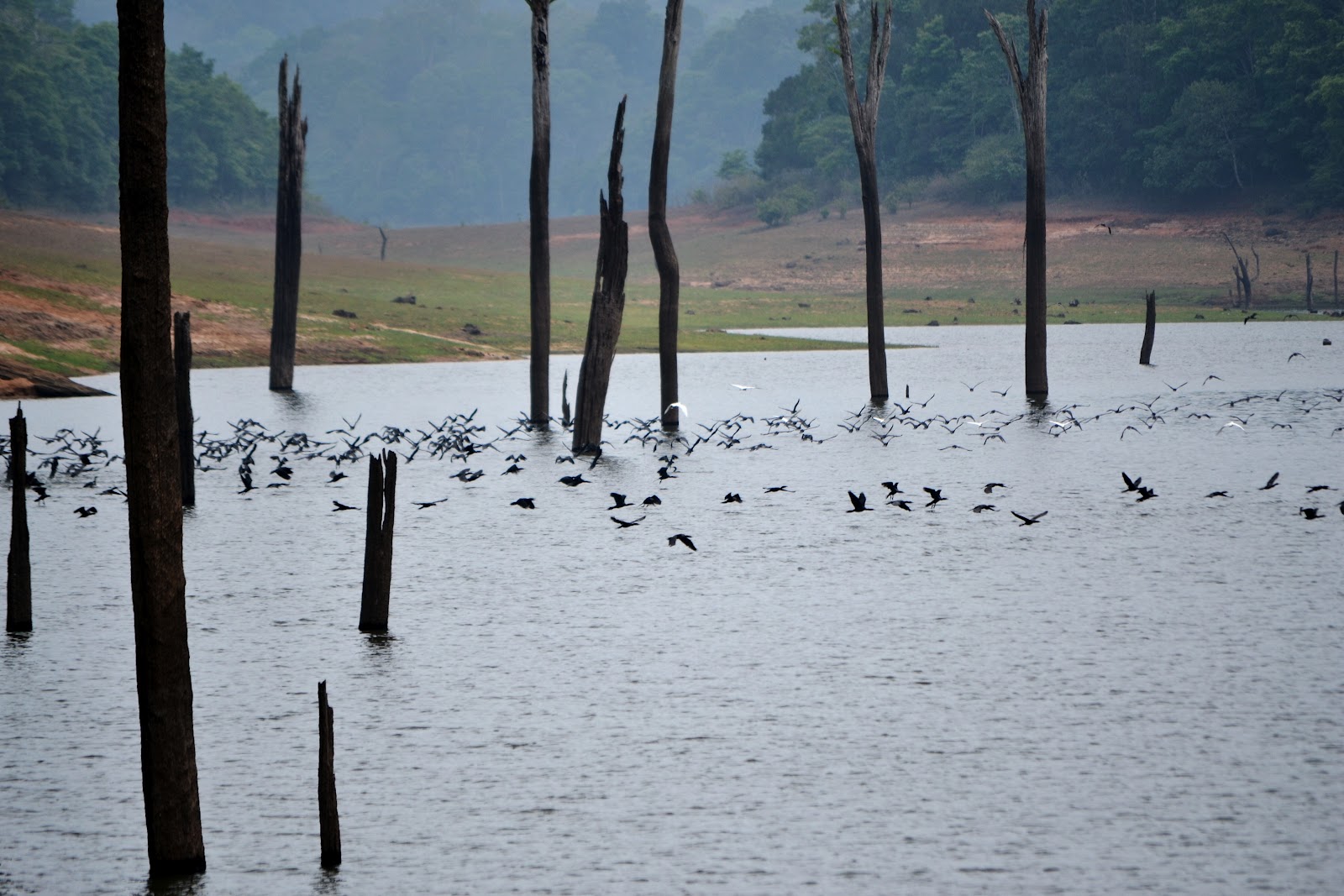
The lake in Periyar Tiger Reserve is filled with birds, literally. Don't believe it? Check these photographs out:


As you can see, a flock of birds, mainly cormorants, were gliding over the water surface. These cormorants are abundant in the reserve, and very often, they tend to fly in large flocks like these over the water surface, and all of a sudden, they would plunge into the water. A few seconds later, their heads and necks would show up, with the rest of their bodies submerged in the water.


I was never good at photographing birds, but this time, due to their abundance, I managed to capture some decent shots of the cormorants.


And sure enough, I guess I'm slowly starting to learn how to shoot birds and other subjects in flight!


A happy couple.


A group of cormorants perching in line along the branch of one of the numerous submerged trees in the lake.


Alright, enough with the Cormorants. I spotted several raptors in the lake too, but well, these birds were fast and pretty far away, and so I couldn't photograph them well with my 200mm. However here's one of them as it flew off with it's fresh catch - a large fish from the lake. He must have had a five-star dinner that evening!


A Yellow-Billed Babbler. This bird was found close to the Visitor Centre in the reserve. I realized why it's called 'Babbler' upon listening to its calls.


More birds coming up next, in 'Birds of Periyar II'!

LinkWithin

Related Posts with Thumbnails